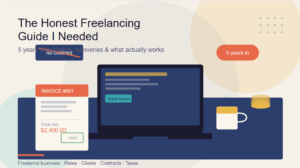
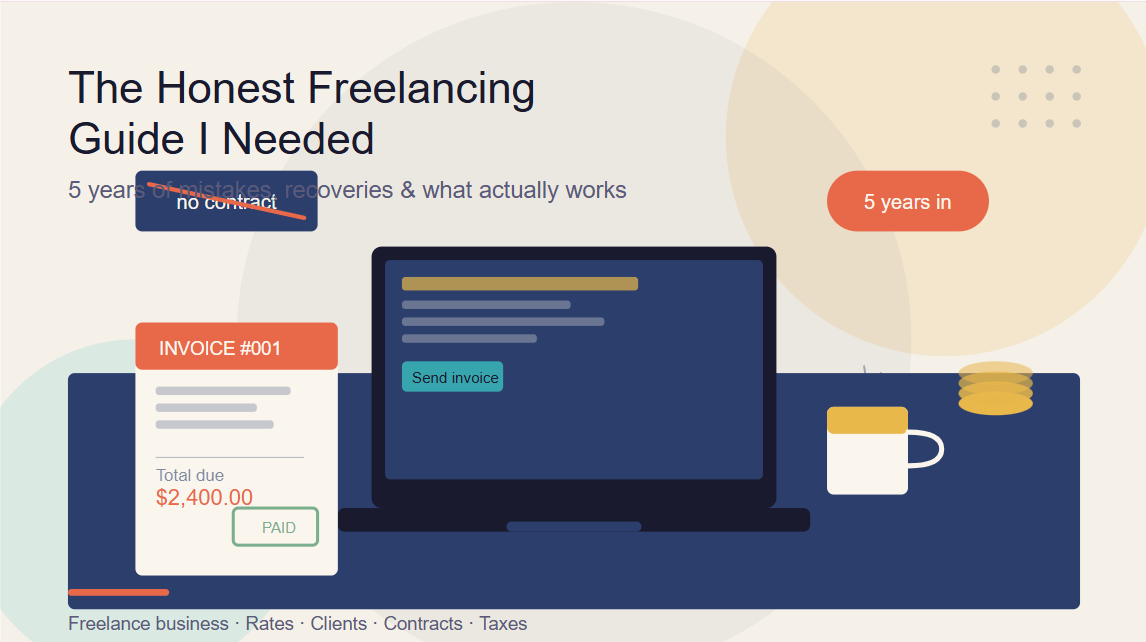
The first invoice I ever sent a client came back with one line: “We don’t pay invoices from individuals. Do you have a company?” I didn’t. I panicked. I spent the next three hours Googling how to register a sole proprietorship while also trying to look professional in a follow-up email.
That was month one of my freelance career. Nobody warned me that “going freelance” involves a lot more than doing the actual work — it involves running a mini-business, whether you want to or not.
Five years later I’ve made most of the classic mistakes, recovered from most of them, and figured out a process that actually works. This is what I’d tell myself back then.
“Freelancing isn’t just doing your skill for money. It’s running a business where your skill happens to be the product.”
The real difference between freelancing and a job
When you have a job, someone else handles finding the work, billing the client, paying taxes, managing scope creep, and chasing late payments. When you freelance, every single one of those things lands on your desk.
This isn’t a warning against freelancing — it’s a heads-up so you don’t get blindsided the way I did. The people who struggle most aren’t the ones with weak skills. They’re the ones who thought freelancing meant “doing the work I’m good at, but from home.” It’s that, plus running a business.
Once you accept that, everything gets easier — because now you can actually prepare for the business side instead of being surprised by it.
What skills actually translate to freelance income
Almost any marketable skill can become a freelance service. The ones with the most consistent demand right now:
Writing
Copywriting, blog content, email sequences, UX writing, technical writing
Design
Graphic design, UI/UX, video editing, motion graphics, brand identity
Development
Web dev, WordPress, Shopify, mobile apps, automation, API integrations
Marketing
SEO, paid ads, social media, email marketing, analytics
Operations
Virtual assistance, project management, bookkeeping, data entry
Consulting
Business strategy, HR, finance, legal (where licensed), niche expertise
The mistake most beginners make: trying to offer everything. “I do design, writing, social media, and video editing!” That’s not a service — that’s a job description. Pick one thing to lead with. You can add services later once you have traction.
Where to actually find clients
There are two types of client sources: platforms and direct outreach. Both work. Neither is passive.
Upwork Best for long-term relationships
Upwork is competitive but it rewards consistency. My first three months on Upwork earned me almost nothing — then I hit five reviews and things changed. The algorithm favors established profiles, so the early grind is real. Once you have a strong profile with JSS (Job Success Score) above 90%, the platform starts working for you. It takes 3–6 months to get there.
I’d recommend Upwork if you’re willing to play a long game and lower your rate initially to build reviews. Don’t bid on everything — bid on 3–5 jobs per week that genuinely match your skills and write proposals that show you actually read the job description.
10–20% platform fee drops as you earn more with each client
Contra Best for zero platform fees
Contra is my current favorite for independent freelancers. Zero commission — you keep 100% of what you charge. The platform is cleaner than Upwork and attracts quality clients, though the volume is lower. If you already have a portfolio and some experience, Contra is worth setting up as a second channel. Their portfolio pages also double as a personal site.
0% commission free for freelancers — clients pay a small fee
LinkedIn direct outreach Best for B2B and professional services
LinkedIn is where I get my highest-paying clients — not from job listings but from outreach. A well-optimized LinkedIn profile + consistent posting about your area of expertise + direct messages to relevant decision-makers is a slow burn that pays off. I send maybe 10 thoughtful connection requests a week to marketing directors and startup founders. Three months of that filled my pipeline better than a year on Fiverr.
The key: don’t pitch in the first message. Build a connection first. Comment on their posts, engage genuinely, then introduce what you do when it feels natural.
Free LinkedIn Sales Navigator ($100/mo) helps at scale but isn’t necessary early on
Fiverr Best for specific packaged services
Fiverr works best when you have a very specific, clearly defined deliverable — “I’ll write a 500-word SEO blog post about [your topic] for $40” sells better than “I offer writing services.” Fiverr’s search algorithm is keyword-driven, so optimizing your gig titles and descriptions matters. The race-to-the-bottom pricing is real at the entry level, but Fiverr Pro and Level 2 sellers can command solid rates.
20% platform fee one of the highest cuts in the industry
Facebook groups & niche communities Most underrated channel
This is the channel most freelancers skip that consistently surprises me. Joining Facebook groups for small business owners, entrepreneurs, or startup founders in your niche and simply being helpful — answering questions, sharing knowledge, not pitching — leads to inbound inquiries. I’ve landed $2,000+ projects from a single helpful comment in a Facebook group. Zero platform fees, warm leads, often faster to close.
Free also applies to Slack communities, Discord servers, Reddit communities
How to price your work
This is where most freelancers get it badly wrong — almost always in the direction of underpricing.
The mistake I made for the first year: I charged what I thought clients would accept, not what my time was actually worth. I was charging $25/hour for copywriting when the market rate was $50–80/hour. I had more clients than I could handle, which felt like success. It was actually just exhaustion for half the pay.
Simple hourly rate formula
Your target annual income $60,000
Billable hours per year (realistic: ~1,000) 1,000 hrs
Base rate before overhead$60/hr
Add 30% for taxes, software, downtime +$18/hr
Minimum viable hourly rate $78/hr
Note: 1,000 billable hours per year sounds low. It isn’t. The rest of your working time goes to finding clients, admin, communication, invoicing, professional development, and unpaid revisions. Most freelancers who track their time carefully find they’re billing 15–20 hours a week, not 40.
Switch to project-based pricing when you can
Hourly pricing punishes you for getting faster. A project rate of $500 for a landing page makes you $100/hr if you finish in 5 hours and $50/hr if it takes 10. Once you know how long projects take you, package them. Clients also prefer project pricing because they know the total cost upfront — it removes the fear of runaway hours.
Getting started — step by step
- Pick one service to offer. Not three. Not five. One. The one you’re most confident delivering and can explain in one sentence.
- Build a 3-piece portfolio — even if you have to do the work free or for a reduced rate to get the samples. No portfolio means no clients. This takes 2–4 weeks and is non-negotiable.
- Set your rate using the formula above. Round up, not down. You can negotiate later — it’s much harder to raise a rate after you’ve already quoted low.
- Choose two client channels to focus on: one platform (Upwork, Contra, or Fiverr) and one direct channel (LinkedIn, communities). Work both consistently for 90 days.
- Write a proposal template that you customize for each job — not a generic copy-paste. The first paragraph should reference something specific about the client’s project. Most proposals don’t do this. Yours will stand out.
- Land your first paying client. Even if it’s small. This is the inflection point — everything before this is setup, everything after is iteration.
- Ask for a testimonial after every good project. This is the single highest-leverage thing you can do in your first year. Social proof compounds.
Tools that actually make freelancing easier
You don’t need a lot of software to start. But a few tools genuinely save hours:
For contracts and proposals: Bonsai or HoneyBook are the two I’d recommend. Both let you send proposals, get contracts signed, and invoice in the same platform. I used Google Docs for my first six months and it was messy. Bonsai cleaned it up immediately.
For time tracking: Toggl is free and excellent. Even if you charge project-based, tracking time teaches you how long things actually take — which makes your project pricing more accurate over time.
For invoicing: whatever your client management tool generates, or Wave (free accounting software) if you want something standalone.
For communication: Notion for project notes and deliverables, Loom for async video explanations to clients (saves dozens of clarification emails), and Calendly for booking discovery calls without the back-and-forth.
Mistakes that trip people up
Mistake #1 — No contract, ever
A handshake deal or email agreement is not a contract. I did a $1,500 project on a handshake for a client who disappeared when it was time to pay. Never again. Use a proper contract with payment terms, scope definition, revision limits, and what happens if the client goes silent. Bonsai and HoneyBook both have solid templates.
Mistake #2 — No deposit upfront
Always charge 30–50% deposit before starting any project. It filters out time-wasters, creates commitment from the client, and means you’re not left entirely unpaid if a project falls apart mid-way. Any serious client will agree to this — it’s standard practice.
Mistake #3 — Scope creep with no pushback
“Can you just add one more thing?” multiplied by ten turns a $500 project into $900 worth of work for $500 pay. Define scope clearly in your contract. When clients request additions outside scope, say: “I’d love to add that — I’ll send a quick change order for the additional work.” This is professional and expected. Most good clients respect it.
Mistake #4 — Feast-or-famine cycles
When you have work, you stop looking for work. Then the project ends and you have nothing. Always be doing some level of outreach or marketing, even when you’re fully booked. Your future pipeline is your responsibility. The freelancers with the most consistent income treat client acquisition as a weekly task, not an emergency response.
On taxes — don’t skip this
Nobody warned me about quarterly estimated taxes my first year and I got hit with a large bill plus penalties in April. Set aside 25–30% of every payment into a separate savings account immediately. In the US, you pay quarterly self-employment taxes. Check your country’s equivalent. This isn’t exciting advice but it’s the most important financial habit you can build in year one.
Freelancing is genuinely one of the most freeing career paths I’ve experienced. But it took me about two years to stop treating it like a job I happened to be doing from home and start treating it like a business I was building.
The practical stuff — contracts, deposits, pricing, client channels — isn’t glamorous but it’s what separates freelancers who burn out from those who build something sustainable. Most of it is learnable in a few weeks. The only way to actually learn it is to start.
Land your first client, do good work, ask for a testimonial, raise your rate on the next one. That’s the whole cycle. Everything else is optimization.