I once watched a 200-page site outrank a 2,000-page site for a highly competitive term and keep that position for two years. The bigger site had more content, more backlinks, and a bigger domain. The smaller one had a faster page and better answers to the specific question people were asking.
That was the moment I stopped thinking about Google ranking as a formula and started thinking about it as a judgment call — one made by an algorithm that’s trying to do the same thing a smart librarian would: put the most genuinely useful result at the top.
I’ve spent six years trying to understand what that judgment actually favors. Here’s what I’ve learned — including some things that took me way too long to figure out.
“Google doesn’t reward the most optimized page. It rewards the most useful one — and ‘optimized’ is just how you help it understand that.”
First — the scale of the problem
Google uses over 200 ranking signals. Nobody outside Google knows all of them. But through patents, documentation, leaked information, and years of testing, the SEO community has a pretty solid picture of which factors genuinely move rankings and which ones are noise.
The honest truth: most ranking discussions spend too much time on minor factors and not enough on the three or four things that actually dominate results. Let me start there.
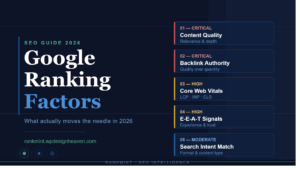
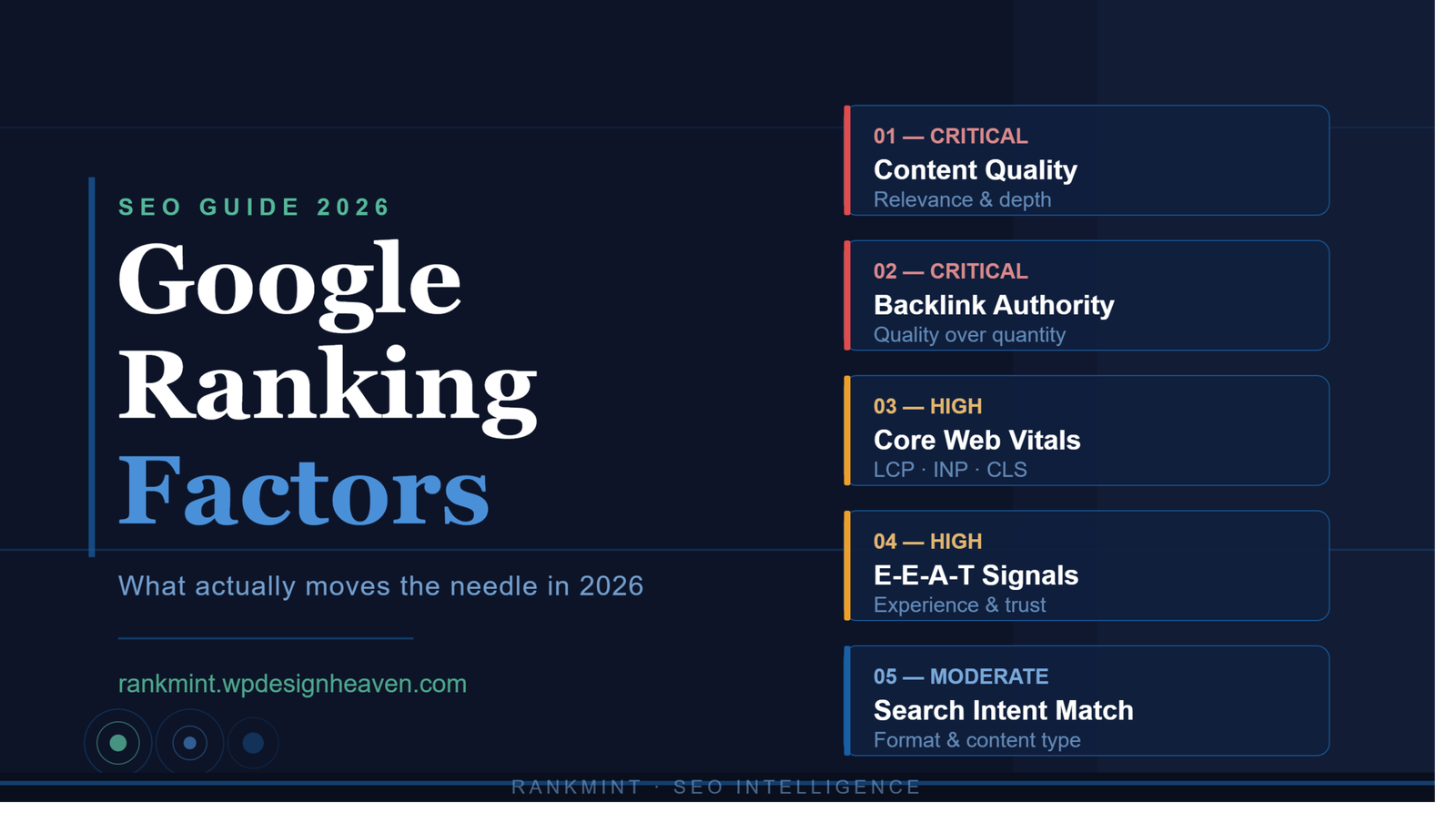
Critical factors — these dominate rankings
Content relevance
Does your page actually answer what was searched?
Critical
Backlink authority
Who links to you and how much do they trust you?
Critical
Search intent match
Is your content the right format for what people want?
Critical
E-E-A-T signals
Does Google trust who wrote this and why?
Critical
The ranking factors that matter — one by one
Content quality and relevance Critical
This is the big one. Everything else is secondary to whether your content genuinely answers what the searcher was looking for. Google’s leaked quality rater guidelines talk extensively about “satisfying” the user’s need — not just including keywords, but actually helping.
I had an article ranking on page two for 18 months. I rewrote it entirely — same topic, same keyword, but I focused on answering the question the way someone who’d actually done the thing would answer it, with real examples and specific details. It hit page one within six weeks. The word count barely changed. The depth did.
What Google looks for in content: comprehensive coverage of the topic, original information or perspective not found elsewhere, appropriate depth for the search intent, and readability that matches the audience. A 3,000-word article that buries the answer in paragraph 20 is worse than a 600-word article that leads with the answer.
Backlinks — still the most powerful signal Critical
After 25+ years of search, backlinks remain the strongest ranking signal Google has. Not because Google loves links — but because a link from a trusted site is a vote of confidence that’s hard to fake at scale.
The nuance most people miss: it’s not about the number of links, it’s about the quality and relevance. One editorial link from a respected industry site does more for most pages than 50 links from random directories. I’ve seen single links from authoritative domains move a page from position 8 to position 2 within weeks.
What matters: links from topically relevant sites, links in editorial content (not footers or sidebars), links from pages that themselves have authority, and link anchor text that reflects what the page is actually about. What doesn’t matter much anymore: the raw count of linking domains if they’re low-quality.
Search intent — the most underestimated factor Critical
I cannot overstate how many times I’ve seen technically well-optimized pages fail because they mismatched search intent. A blog post targeting a keyword where every competing result is a product page. A 5,000-word guide targeting a keyword where everyone wants a quick definition. Wrong format for the intent = low rankings regardless of quality.
The fastest way to check intent: Google the keyword and look at the top 5 results. Are they listicles? Deep guides? Product pages? Videos? FAQs? That’s your signal. Google has already decided what kind of content best satisfies that query. Match the format before you worry about anything else.
Intent types to recognize: informational (how-to, what-is), navigational (finding a specific site), commercial (comparing options), transactional (ready to buy). Each requires a different content approach.
E-E-A-T: Experience, Expertise, Authoritativeness, Trust Critical
Google added the first “E” (Experience) to their quality guidelines in 2022 — and it’s increasingly important. It’s not enough to be an expert. Google now looks for evidence that you have real, first-hand experience with what you’re writing about.
For YMYL topics (health, finance, legal), this is especially strict. A financial advice article written by a named, credentialed author with an author bio, links to their professional credentials, and a site with clear contact information will outrank an anonymous one with identical content. Every time.
E
Experience
Has the author actually done this? First-hand accounts, photos, personal examples.
E
Expertise
Do they know the topic deeply? Qualifications, specific knowledge, nuanced details.
A
Authoritativeness
Is the site/author recognized in the field? Links, mentions, citations by others.
T
Trust
Clear ownership, contact info, accurate content, honest about limitations.
Core Web Vitals and page experience High impact
Google made Core Web Vitals an official ranking factor in 2021 and has been tightening the thresholds since. These aren’t “nice to have” metrics anymore — pages with poor scores are demonstrably disadvantaged in competitive niches.
I migrated a client’s site from a shared host to Cloudways and their average LCP improved from 4.2 seconds to 1.8 seconds. Within two months, organic traffic increased 23%. Some of that was correlation, but the timing was hard to ignore.
<2.5s
LCP
Largest Contentful Paint — how fast main content loads
<100ms
INP
Interaction to Next Paint — how fast the page responds to clicks
<0.1
CLS
Cumulative Layout Shift — how stable the page layout is while loading
Check your scores with Google Search Console (the Core Web Vitals report uses real field data from Chrome users) or PageSpeed Insights for lab data. Fix your worst metric first — usually LCP on most sites.
Technical SEO foundations High impact
Technical SEO doesn’t move rankings the way content and links do — but technical problems can absolutely prevent good content from ranking at all. Think of it as the floor, not the ceiling.
The technical issues I’ve seen tank sites: pages blocked by robots.txt accidentally, duplicate content from www vs. non-www, missing canonical tags causing self-competition, JavaScript-rendered content Google couldn’t index, and crawl budgets wasted on paginated archive pages instead of actual content.
The basics that every site needs right: HTTPS, mobile-friendly design, XML sitemap submitted to Search Console, no crawl errors on important pages, proper canonical tags, and reasonable page speed. Beyond that, the specifics depend heavily on your site type.
On-page SEO signals Moderate
On-page signals are important but overhyped relative to the factors above. Title tags, H1s, meta descriptions, internal linking, image alt text, keyword placement — these matter, but a page with perfect on-page optimization and weak content won’t beat a page with average on-page and exceptional content.
The on-page elements that actually impact rankings: title tag (still the strongest on-page signal for what a page is about), heading structure, keyword placement in the first 100 words, internal links from relevant pages, and structured data for eligible content types.
Now use these factors to find the right keywords
Understanding ranking factors only helps if you’re targeting keywords you can actually rank for. Before you create content around any keyword, you need to know its competition level, search intent, and related terms — so your content is built around what Google actually wants to see for that query.
The tool below lets you explore keywords by intent, difficulty, and related clusters so you can build a content plan that aligns with how Google evaluates pages:
AI-Powered — Free to use
RankMint Keyword Explorer
Enter any topic to discover keyword clusters, search intent signals, difficulty scores, and content ideas — everything you need to target keywords Google will actually rank you for.
✨ AI-Powered Keyword Explorer
Enter any topic, keyword, or domain to discover high-impact keywords with volume, CPC, difficulty, and intent data — plus AI-generated content ideas.
Discover High-Impact Keywords
Once you’ve identified a keyword with the right intent and realistic competition level, come back to the factors above as your content checklist — match intent, demonstrate experience, earn relevant links, and make sure your page loads fast.
How to actually improve your rankings — step by step
- Run a Google Search Console audit first. Check your Coverage report for indexing errors, Core Web Vitals for speed issues, and Performance report for keywords you’re ranking 8–20 for (quickest wins).
- For any page you want to rank: Google the target keyword yourself. Study the top 5 results — format, depth, angle. That’s your content brief.
- Rewrite or improve any page that’s been stagnant for 6+ months. Often the fastest path to ranking improvement isn’t new content — it’s making existing content genuinely better.
- Fix technical problems before building new content. A site with crawl errors, slow speed, or indexing issues won’t benefit much from more content.
- Build one quality link per month to your most important pages through genuine digital PR, guest posts on relevant sites, or creating linkable assets like original research or tools.
- Add E-E-A-T signals: author bios with credentials, first-hand experience sections, real photos, and updated content dates (only when you actually update the content).
- Track rankings weekly with a tool like Ahrefs, Semrush, or free tools like Google Search Console and SERPRobot. Give changes 6–8 weeks to show impact before drawing conclusions.
The single fastest ranking win most sites leave on the table
Find pages on your site ranking positions 8–15 for keywords with decent search volume. These pages are close — Google already thinks they’re relevant. A focused update (adding a missing angle, improving the intro, adding internal links from stronger pages) often moves them to page one within 4–8 weeks. Much faster than trying to rank new pages from scratch.
Mistakes that actively hurt rankings
Mistake #1 — Keyword stuffing in 2026
Google’s natural language understanding is sophisticated enough that forcing a keyword into every other paragraph not only fails to help — it can trigger quality penalties. Write naturally. Use the main keyword where it fits, and let related terms appear organically. If your content sounds unnatural when read aloud, Google’s systems will likely notice that too.
Mistake #2 — Ignoring cannibalization
If multiple pages on your site target the same or very similar keywords, they compete against each other and split ranking signals. Google has to pick one — and often picks neither, ranking both weakly. Consolidate overlapping content into one strong page. I’ve seen sites triple their organic traffic purely by merging duplicate topic coverage.
Mistake #3 — Buying low-quality links
Link spam tactics that worked in 2015 now risk manual penalties or algorithmic suppression. Google’s Spam Brain system catches most link schemes algorithmically. One good editorial link from a respected site does more than 100 purchased links and carries zero risk. It’s slower, but it’s the only approach that compounds without backfiring.
Mistake #4 — Publishing then forgetting
Content freshness is a real factor for many queries, especially anything time-sensitive. Articles left to gather dust lose rankings as fresher, updated content from competitors overtakes them. Build a content refresh schedule — I revisit my top 20 pages once a year minimum, updating statistics, examples, and outdated references.
On AI-generated content and rankings
Google has stated it doesn’t penalize content for being AI-generated — it evaluates helpfulness regardless of how the content was produced. What it does penalize is low-quality, thin, or unhelpful content, which AI can certainly produce at scale if used poorly. The standard is the same: does this content genuinely help the person who searched for it? If yes, how it was written is irrelevant. If no, it won’t rank regardless of the production method.
After six years of watching what actually moves rankings, the pattern is consistent: Google rewards pages that genuinely deserve to rank. Content that actually helps, from sources that are credible, on sites that are fast and accessible.
The factors that matter most — content quality, backlink authority, intent matching, E-E-A-T, and page experience — are all just different ways of asking the same question: is this the best result for someone searching this query right now?
Answer that question better than everyone else on page one, and the algorithm has a reason to put you there. The technical stuff, the on-page optimization, the keyword research — all of that is just how you help Google understand that your page deserves that position.